
Nigeria’s Inflation Rate Hits 15.15% in December 2025 as Food Prices Ease
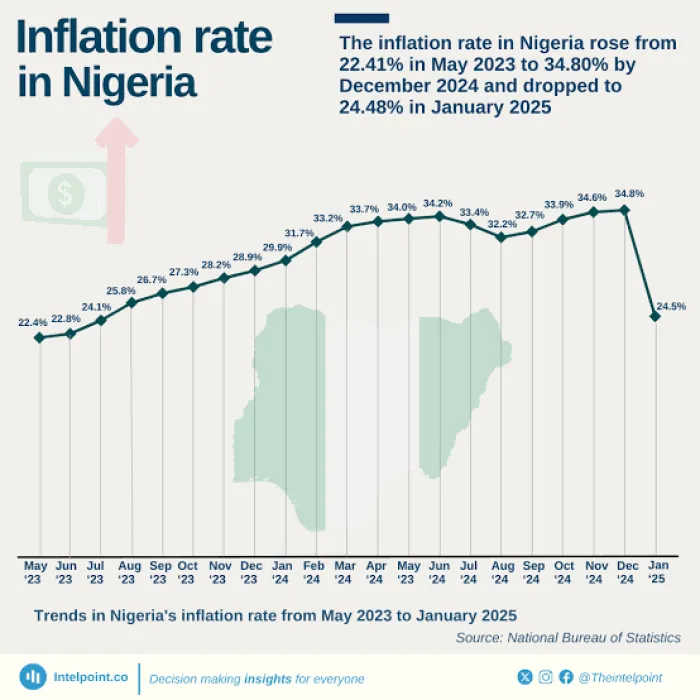
Nigeria’s headline inflation rate eased to 15.15 percent in December 2025, according to data released on Tuesday by the National Bureau of Statistics (NBS), reflecting a notable slowdown in price pressures as food prices declined during the festive season.
The Statistician-General of the Federation, Prince Adeyemi Adeniran, announced the figures following a comprehensive rebasing exercise that shifted the Consumer Price Index to a new 2024 base year. Officials said the change offers a more accurate picture of current consumer spending patterns across the country.
The report showed that month-on-month headline inflation slowed sharply to 0.54 percent in December, down from 1.22 percent in November. The moderation was driven largely by a surprise fall in food prices over the holiday period.
Food inflation recorded a month-on-month decline of 0.36 percent, reversing the 1.13 percent increase seen in November. The NBS attributed the drop to lower average prices of key staples such as tomatoes, garri, potatoes, onions, carrots, eggs, millet, beans, and wheat grain.
On a year-on-year basis, however, food inflation remained elevated at 10.84 percent, highlighting persistent cost pressures despite the short-term relief. State-level data showed wide variations, with Yobe posting the highest food inflation rate at 15.25 percent, while Akwa Ibom recorded the slowest rise at 4.34 percent.
Core inflation, which excludes volatile agricultural produce and energy, remained sticky at 18.63 percent year-on-year. Energy stood out as the only major sub-index to record a notable increase during the month, rising by 2.74 percent, while other components such as farm produce and services experienced declines or marginal growth.
The NBS said the 15.15 percent headline inflation rate was mainly driven by food and non-alcoholic beverages, which contributed 6.06 percentage points. Restaurants and accommodation services added 1.96 points, while transport contributed 1.62 points. Recreation, sport, and culture had the smallest impact at 0.05 points.
A breakdown by location showed divergent trends between urban and rural areas. Urban inflation stood at 14.85 percent year-on-year, with a month-on-month increase of 0.99 percent. Rural inflation came in at 14.56 percent year-on-year, but recorded a month-on-month decline of 0.55 percent, suggesting that easing food prices had a faster impact in rural markets.
Inflationary pressures also varied widely across states. Abia recorded the highest year-on-year headline inflation at 19.03 percent, followed by Ogun at 18.80 percent and Katsina at 18.66 percent. Sokoto posted the lowest rate at 8.61 percent, with Plateau at 9.05 percent and Kaduna at 10.38 percent.
The NBS cautioned against direct comparisons across states, noting differences in consumption patterns and the weighting of items in each state’s inflation basket.
Prince Adeniran said the new reporting framework, based on a 2023 weight reference period, provides a more modern and accurate reflection of Nigerian consumers’ realities heading into 2026.

Write a Comment