
Tinubu’s Aide Abba Isa Highlights Economic Benefits of Establishing Farm Cities for PWDs
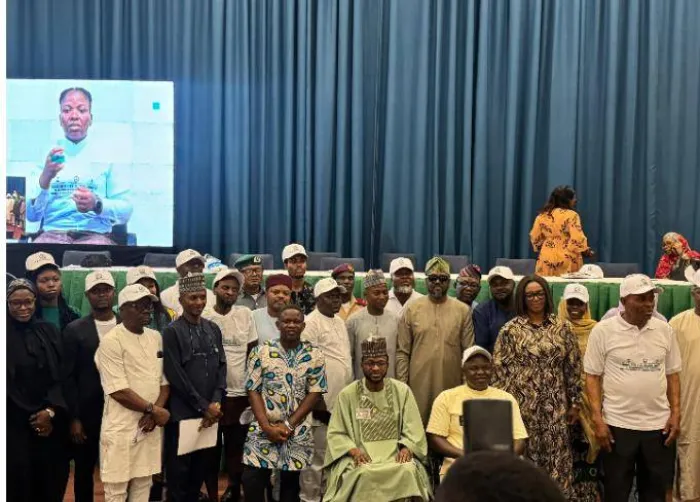
The Senior Special Assistant to the President on Special Needs and Equal Opportunities, Hon. Mohammed Abba Isa, has underscored the far-reaching economic benefits of establishing Farm Cities for Persons With Disabilities (PWDs) across the six geo-political zones of Nigeria.
Hon. Abba Isa made this known at the historic inauguration of the Local Organizing Committee for the planning and mobilization of funds towards the establishment of PWD Farm Cities nationwide.
The initiative is spearheaded by the National Commission for Persons with Disabilities (NCPWD), an agency under the Federal Ministry of Humanitarian Affairs and Poverty Reduction, in partnership with the Peace for Humanity Foundation.
In his remarks, the Presidential aide warmly commended the NCPWD and the Peace for Humanity Foundation for conceiving what he described as a bold and transformative initiative capable of redefining economic inclusion for Persons With Disabilities in Nigeria.
He noted that agriculture remains the most expansive and absorbing sector of the Nigerian economy, with vast value chains spanning cultivation, processing, packaging, storage, marketing, and export.
According to him, the sector possesses the capacity to employ millions of Nigerians if properly structured and supported.
The establishment of Farm Cities specifically designed for Persons With Disabilities will open structured, accessible, and inclusive opportunities for PWDs who are already farmers, while also encouraging new entrants to embrace agriculture as a viable and dignified means of livelihood,” he stated.
Hon. Abba Isa observed that across rural communities in Nigeria, many Persons With Disabilities are already engaged in farming under harsh and difficult conditions. He lamented that most lack access to modern equipment, improved seedlings, financing, irrigation systems, extension services, and structured markets.
They labor daily with resilience but without adequate institutional support. This project seeks to change that narrative,” he added.
He explained that the proposed Farm Cities would serve as organized hubs of agricultural productivity—centers where accessibility, technology, mechanization, capacity building, and financing converge.
Through the initiative, PWD farmers are expected to gain access to funding windows, government intervention programmes, development partners’ support, modern farming techniques, and integration into national and international agricultural value chains.
Aligning the project with President Bola Ahmed Tinubu’s Renewed Hope Agenda, the SSA emphasized that the initiative would significantly advance inclusive economic empowerment for Persons With Disabilities and other vulnerable groups. He stressed that it would transition many from subsistence to sustainability, from marginalization to productivity, and from exclusion to economic relevance.
They labor daily with resilience but without adequate institutional support. This project seeks to change that narrative,” he added.
He explained that the proposed Farm Cities would serve as organized hubs of agricultural productivity—centers where accessibility, technology, mechanization, capacity building, and financing converge.
Through the initiative, PWD farmers are expected to gain access to funding windows, government intervention programmes, development partners’ support, modern farming techniques, and integration into national and international agricultural value chains.
Aligning the project with President Bola Ahmed Tinubu’s Renewed Hope Agenda, the SSA emphasized that the initiative would significantly advance inclusive economic empowerment for Persons With Disabilities and other vulnerable groups. He stressed that it would transition many from subsistence to sustainability, from marginalization to productivity, and from exclusion to economic relevance.

Write a Comment