
FG to Establish Cancer Centres in All States, Urges safety in Radioactive Substances
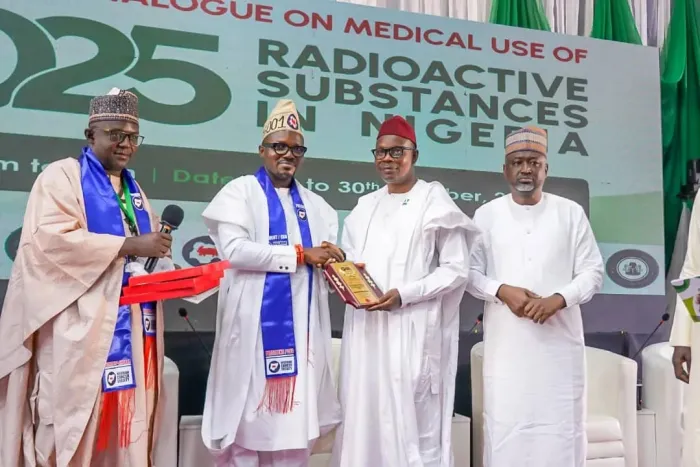
The Federal Government has restated its commitment to ensuring the safe medical use of radioactive substances in Nigeria, as key stakeholders and health experts gathered in Abuja for the maiden National Dialogue on Safe Medical Use of Radioactive Substances.
Delivering the keynote address, Minister of State for Health and Social Welfare, Dr. Iziaq Adekunle Salako, described the event as “a crucial step toward strengthening Nigeria’s health infrastructure and regulatory systems amid expanding cancer treatment and diagnostic services.”
Salako explained that radioactive substances play critical roles in disease diagnosis and treatment but require strict regulation to ensure safety.
> “Protocols must be in place to minimise exposure and manage waste,” he said.
The Minister commended the Nigeria Nuclear Regulatory Authority (NNRA) for maintaining rigorous licensing procedures for vendors and hospitals handling ionising radiation, describing these as “necessary safeguards to prevent devastating consequences.”
He cautioned stakeholders against complacency, warning that while ionising radiation has major health benefits, it also carries risks such as cancer, cataracts, infertility, and birth defects.
> “Ionising radiation can threaten national security if not strictly regulated,” he added.
Salako noted that the International Atomic Energy Agency (IAEA), in its July 2025 imPACT Review Report, praised NNRA’s regulatory efficiency but highlighted gaps such as poor identification of radiation zones and absence of diagnostic reference levels (DRLs).
He directed the National Nuclear Medicine Technical Working Group (TWG) to collaborate with the NNRA to establish DRLs “within the shortest possible time” to minimise patient exposure during diagnostic procedures.
Highlighting ongoing government investments in cancer care, the Minister revealed plans to establish or upgrade six Cancer Centres of Excellence annually, ensuring that every state will have at least one comprehensive cancer centre by 2031.
He noted that while this expansion would increase access to care, it also underscores the need for stronger safety oversight and monitoring systems.
The Minister further disclosed that the TWG has developed a National Nuclear Medicine Policy and Strategic Plan, scheduled for launch in early 2026. He urged participants to produce actionable policy briefs to advance radiation safety and oncology services.
> “Let us build a Nigeria where no citizen dies needlessly from cancer because advanced care is unavailable,” he charged.
---
Experts Call for Improved Access, Stronger Regulation
Speaking at the event, President and CEO of the Nigerian Cancer Society (NCS), Prof. Abidemi Omonisi, described the dialogue’s theme — “Medical Use of Radioactive Substances in Nigeria” — as timely, stressing the need to prioritise safety in cancer treatment.
He warned that radiation and smoking remain two major environmental factors linked to most cancers and called for improved access to safe radiological equipment.
> “Unsafe radiation practices could have dire consequences,” he cautioned.
Omonisi expressed concern over the shortage of anti-cancer drugs, worsened by the exit of major pharmaceutical firms from Nigeria.
> “If more firms withdraw, the impact on patients will be catastrophic,” he said.
He lamented that the Nigerian Cancer Health Fund (NCHF) — once a crucial support system for patients — has suffered severe setbacks, making treatment unaffordable for many.
To address this, he revealed that the NCS has set up a Fact-Finding Committee, led by a stage IV breast cancer survivor and an investigative journalist, to examine the challenges in cancer care financing. The report is expected in November.
Highlighting NCS achievements, Omonisi listed the creation of a ₦100 billion National Cancer Intervention Fund, formation of the Nigerian Coalition for Cancer Survivors (NCCS), and Nigeria’s selection to host the 5th Africa Hepato-Pancreato-Biliary Cancer Consortium International Conference in 2026.
> “We now have NCS chapters in all 36 states and 14 countries worldwide,” he said. “Nigeria is fast emerging as a hub for cancer research and care in Africa.”
He also announced that the NCS 2025 Leadership Excellence Award would be presented to Dr. Salako for his “humility, open-door policy, and leadership in advancing cancer care.”
---
NNRA Decries Poor Compliance Among Hospitals
Also speaking, Chairman of the Nuclear Medicine Technical Working Group, Dr. Kehinde Ololade, said the group was working to improve access to radiation equipment, bridge human resource gaps, and enhance radiation safety across the country.
> “We must not work in silos,” he said. “Collaboration among regulators, hospitals, and industry partners is key.”
Representing the NNRA Director-General, Prof. Yau Usman Idris, the General Manager for Medical Applications, Fatima Ige, revealed that only three out of 15 federal hospitals currently hold valid operational licenses for radiation use.
> “Most facilities are still under construction or awaiting authorisation,” she said.
Ige identified key challenges such as inadequate training, weak safety policies, poor maintenance culture, and insufficient funding.
> “Many centres were built without proper design and construction licenses,” she noted. “There must be a written policy prioritising safety — management commitment remains our biggest gap.”

Write a Comment