
Building a Sustainable Future for Grassroots Sports in Nigeria
By Monday Nas Ozoya
Grassroots sports in Nigeria have a bright future, but this future is not guaranteed. Nigeria has remained one of the most significant sources of athletic talent in Africa, but raw talent alone cannot drive sustainable development. Nigeria needs to shift away from personality-based initiatives and adopt systemic, quantifiable, and safeguarded sport ecosystems to realise potential and drive productivity.
Why the Potential of Nigeria is High.
The Nigerian demography and cultural passion for sports remain unmatched.
• A large base of young people and community interest in football and sports.
• Great natural ability and a competitive culture in street sports.
• Increasing demand for scouting across the world, particularly for footballers.
• Reducing governmental influence and increasing the involvement of the private sector and the diaspora in sports as both entertainment and economic opportunities.
When effectively designed, these assets have the potential to make grassroots sport a national tool for educational inclusion, local job creation and the enhancement of public health.
The Structural Gaps in Nigeria's Sports
Despite the promises, there are still structural weaknesses restricting this potential:
• A weak school sports system and inconsistent competitions
• Poor infrastructure and limited access to quality coaching.
• Limited athlete welfare, first aid awareness, insurance, and safeguarding standards.
• Inconsistent financing and governance challenges that discourage institutional investment.
The talent pipeline in Nigeria will remain arbitrary and not by design unless reforms are implemented.
What the Next Decade Could Be (2026–2035).
This is likely to develop into a hybrid model:
• Agility and partnership with private entities will ensure that community academies move faster than government programmes.
• Technology - video analytics, scouting digital platforms, etc. - will reward organisations that can capture and provide information in a transparent manner.
• Grassroots sports will be characterised by career orientation: education, scholarship schemes, and the openness of contracts will become the rule, not the exception.
• Women's sports will take a leap forward in favour of security, honour and professionalism.
The Immediate Focus for Nigeria
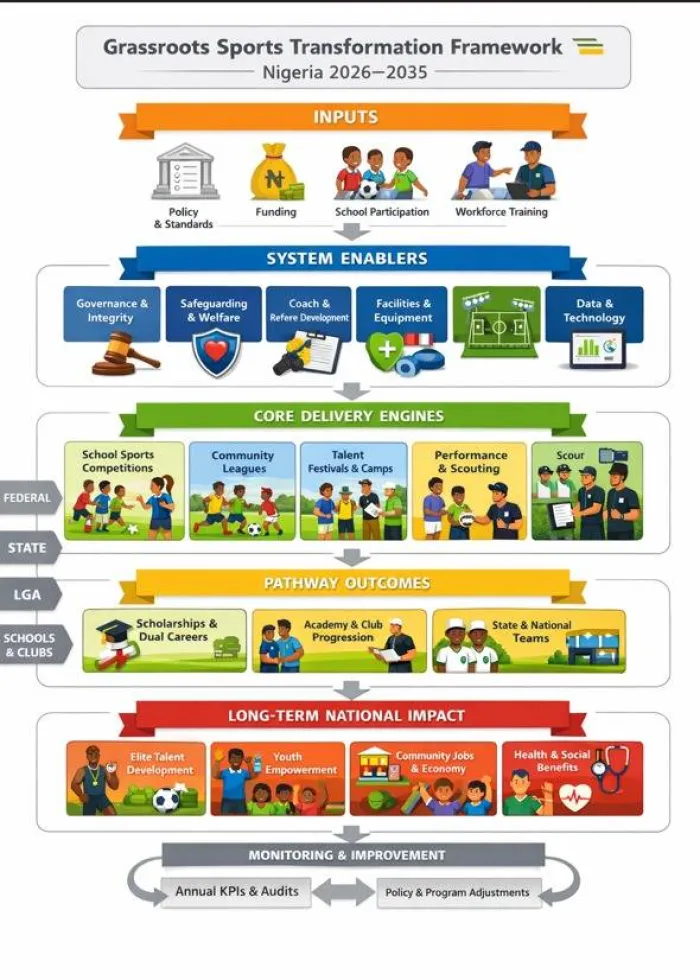
The following growth will be based on five strategic pillars:
• National calendars and teacher/coach development (Revitalising school and inter-community competitions).
• Official community leagues with registered and verified associations, referees, and disciplinary measures. (Formalising local leagues)
• Coaching certification at grassroot to improve the standards of training (Investing in coaching education and grassroots licensing)
• Protection and welfare of athletes as non-commercial standards of governance (Embedding safeguarding, first aid, insurance and medical screening as baseline standard).
• Sustainable financing by business sponsorship programmes, working with the diaspora, Corporate Social Responsibilities (CSR) and monetising digital media.
The Critical Risks
The problems of corruption, poor governance, the exploitation of athletes, politicisation, and the lack of cooperation among schools, clubs, and states may still pose a threat to grassroots development in Nigeria. In the absence of accountability, growth will just be sporadic.
What Success Looks Like
Success will be measured in Nigeria as:
• Achieving a reliable national pathway from grassroots sports to elite levels.
• A functional data system tracking athlete development
• Talent pathways- Competitions organised on a regular basis at the community level.
• A safeguarded, safe and regulated environment.
• A credible governance and welfare structures that attract institutional trust.
Once structure, welfare and integrity are embedded, the sporting dream in Nigeria will begin to change its rudimentary promise into system excellence.
In essence, the future of grassroots sports in Nigeria will belong to those who can adapt talent into structure and vision into verified systems.
A suggested Grassroots Sport Transformation Framework, Nigeria 2026 - 2035

Write a Comment